The H-Factor

Reducing Entropy

Recent Posts

Welcome

Recently our previous blog service (Typepad) ended their business – so, we have a new home. It will take a bit to get images back and displaying properly, but we are working on it! Final pageview count of original Typepad blog: 387,232

Using the Hydratec Software Download Area

Hydratec uses ShareFile to distribute our software installs and updates. New customers, or those without access, must request access to be able to get at these downloads. Access is only available to customers with a Hydratec subscription or those on an update plan. You can access the download area and request access by picking the…

Redefining Blocks

So, you have a situation where you have a particular block in your drawing, and you want to change the block and have your drawing updated with that new block. If you don’t have that block already defined in your drawing, or you can purge it out of the drawing, then you don’t need to…

May 2025
M T W T F S S
 1234
567891011
12131415161718
19202122232425
262728293031  

A customer called today asking how to enter a 1″ black plastic underground pipe for the calc. This particular situation sounded unique enough that I did not tell him to add that pipe type to our database, as I would have if he expected to see this pipe type used repeatedly. I told him to just enter in the pipe info directly into the calculation by entering the actual diameter (not nominal) and the C-Factor:
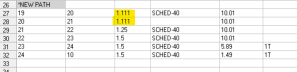
This is all that is needed by the program to calculate the friction loss. The Dia. column can contain entirely Actual diameters, or Nominal, or a mix of both.

When the calculation is initiated, a dialog box will appear for each unique pipe diameter, asking you what nominal diameter it represents:
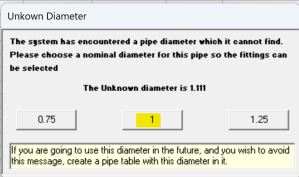
I picked 1″, as that is what the nominal diameter in this example was. This value is recorded in the data, so you will not be asked again for the nominal for this particular diameter.

Posted in

Leave a comment